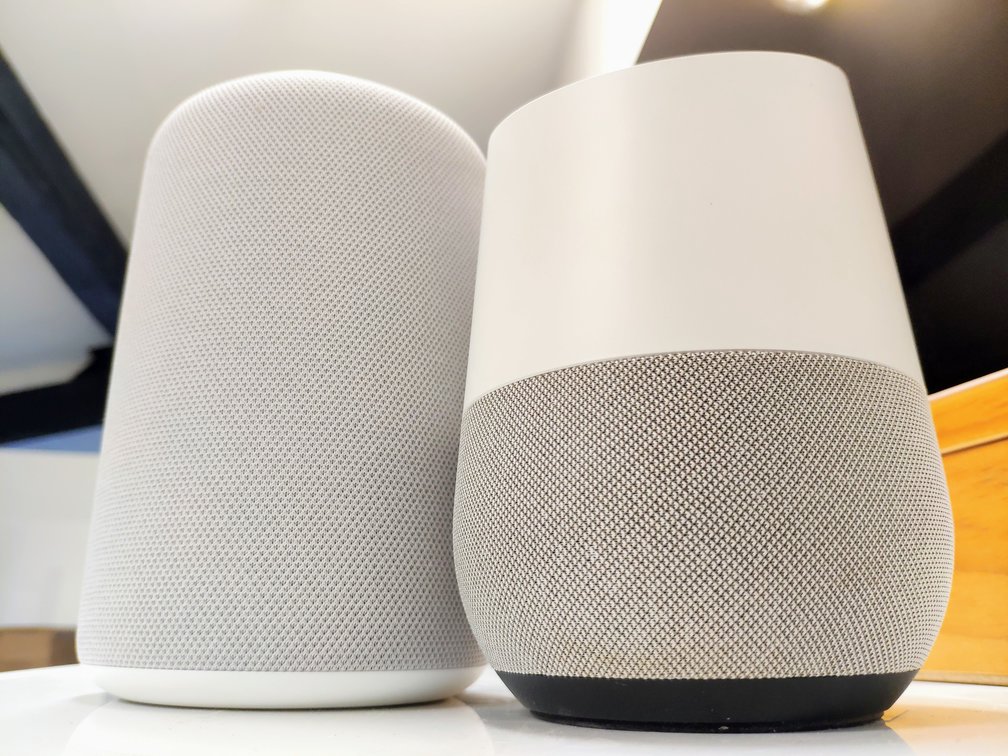
The Google Home and Amazon Echo Plus (2nd generation) are directly competing smart speakers. With a similar format, identical voice assistant features, and comparable acoustic choices, they nonetheless offer a considerably different user experience. We will also tell you which one sounds better…
Smart speakers, what for?
The voice assistant of the Google Home and Amazon Echo Plus allows users to control them by voice. For playing music, for example (subscription required for Spotify, Deezer, Google Play Music, or Amazon Music). To listen to the radio, get news updates, discover cooking recipes, control compatible heating and lighting systems, or even start a series on Netflix. To do this, simply address the Google Home speaker by saying “OK Google” and “Alexa” with the Amazon Echo Plus speaker.

Amazon Echo Plus vs Google Home: which has the better voice?
In French, the female voice of the Google assistant is a real success. Aside from a few oddities in the pronunciation of English terms, Google’s synthetic voice is astonishingly natural. Alexa sounds older, less alert, often robotic and cold.

Amazon Echo Plus vs Google Home: what music services do the assistants support?
If you plan to listen to your music from a streaming service using only voice control, you will have to forgo Qobuz and Tidal. Speakers with Google Assistant or Alexa can only draw from Spotify and Deezer. Google Play Music and YouTube Music are added for compatible Google products, and Amazon Music for compatible Alexas.
If you have a subscription to Tidal or Qobuz, voice control is currently impossible.
Amazon Echo Plus vs Google Home: what music services are compatible without an assistant?
All for the Google speaker. Only Amazon Music for the Amazon Echo Plus. Google has developed Chromecast technology over the past few years, integrated into many connected amplifiers, home theater amplifiers, WiFi speakers, and of course the Google Home speaker. The apps for Spotify, Deezer, Qobuz, Tidal, Google Play Music, or TuneIn support Chromecast. You press a button in the Deezer interface, for example, choose the Google Home speaker, and the streaming begins.

This is impossible with the Amazon Echo Plus speaker, except by using the Amazon Music app. This is understandable, as Amazon has not – for now – developed technology comparable to Chromecast. However, when a track is requested from Alexa on Spotify, the Amazon Echo Plus speaker appears in the Spotify app as a controllable device. You can then take control back with the Spotify app until it is closed.

Amazon Echo Plus vs Google Home: which is more convenient for listening to audio files?
Listening to audio files from your smartphone or tablet is not so simple with smart speakers. The principle is that the speaker connects to the music server, preventing direct transmission from a smartphone. How to do it? Google has thought of this, and Google Play Music offers cloud storage for your MP3 files. It’s completely free (no subscription) and you can upload up to 50,000 files from your smartphone or PC. If your files are in FLAC format, they will be transcoded to MP3 (@ 320 kbps), with very good quality. If you organize your files into playlists, you can simply ask the speaker to play the one of your choice.

Amazon does not offer any free cloud storage solution, which is essential for listening to your MP3 files on the Amazon Echo Plus (or any other compatible Alexa speaker). Therefore, you must subscribe to Amazon Music Unlimited (and not just Prime).
Amazon Echo Plus vs Google Home: what is the ideal streaming service for these speakers?
Google Play Music or Amazon Music (Prime/Unlimited), obviously. Both services have about the same number of songs and each requires a monthly subscription. Google and Amazon charge €9.99/month for unlimited listening. However, Amazon offers limited access to 2 million tracks and up to 40 hours of listening each month for subscribers to its Prime delivery service.
Both services allow offline listening and audio file downloads. The codec used is MP3 for both, with excellent listening quality (compared to Spotify, for example). Google Play Music offers any Google account holder (Gmail) the ability to upload their own MP3 files to the cloud, up to 50,000. If your files are in FLAC format, the upload module will transcode them to MP3 at 320 Kbps. This Google MP3 cloud storage function is therefore completely free and allows you to play your own audio files on the Google Home speaker.
 The Amazon Echo Plus speaker is equipped with an analog line input, switchable to line output.
Amazon Echo Plus vs Google Home: music control via an app
Google has the advantage here. Many applications support the Chromecast protocol. Spotify, Deezer, Tidal, Qobuz, Tune In, Play Music regarding streaming services. You can therefore command the Google Home speaker to play a track by asking it, but also through any application by pressing the Cast button.
For the Amazon Echo Plus speaker, this is only possible from the Amazon Music app. Therefore, you must have chosen this streaming service. It works more or less with Spotify as well, although the speaker is not officially Spotify Connect. In practice, you must ask Alexa to play a track on Spotify. Then, the Amazon Echo Plus speaker is visible in the Spotify app, and you can control it from the app.
Amazon Echo Plus vs Google Home: which is easier to handle?
Amazon has taken no risks, and its speaker features classic yet elegant lines. Acoustic fabric everywhere, an LED ring on top, four buttons on top, and the connectivity at the bottom of the speaker. Google has dared to be original, with sharp curves. The top of the speaker is tilted forward, the dozen multicolored LEDs are invisible, all controls are touch-sensitive (except for the microphone mute button at the back), and the connectivity is hidden under the speaker (angled power connector). The Google Home speaker is also smaller.
 The Amazon Echo Plus speaker on the left, with pressable buttons, and the Google Plus speaker on the right, fully touch-sensitive.
Amazon Echo Plus vs Google Home: home automation control
We did not conduct a home automation control test, as we do not have connected bulbs, compatible heating, or roller shutters in our premises. However, both speakers are compatible with many devices. Unlike the Google Home, the Amazon Echo Plus speaker includes a ZigBee controller (hub), which allows it to directly control certain devices – without the need for an additional hub. Philips Hue bulbs, for example, can be managed without the Philips Hue Bridge hub, although with fewer possibilities (limited scenarios and programming, fewer color choices…).

Amazon Echo Plus vs Google Home: which is easier to set up?
The setup principle is the same for both speakers: you need to use an app (iOS, Android). However, the Google Home app automatically detects the speaker and “guides the user.” The Amazon Alexa app requires you to specify which model (and even generation) you want to use. Beyond that, the Google Home app is more user-friendly. Alexa needs to mature, and the Echo Plus speaker should not update in the middle of listening to a music track.
 The Amazon Alexa app is necessary for setting up the Amazon Echo Plus speaker.
  You will need to tell the app which speaker you want to install… too bad it doesn’t detect it automatically.
Amazon Echo Plus vs Google Home: the best for Netflix?
Google has the advantage. To ask to watch the first season of Kingdom on Netflix, you need to have, in addition to a Netflix subscription, a television running on Android TV (or an Android TV player). “OK Google, play Kingdom on Netflix” indeed turns on the television and starts the Korean zombie series. In contrast, Alexa will leave you hanging… for now. Amazon has not announced a partnership in France with TV manufacturers to integrate Fire TV, its OS for televisions. The Amazon Fire TV Stick 4K HDMI player should, if it is actually marketed in France (it is in England and Germany), solve this problem. And even allow us to ask the Amazon Echo Plus speaker to watch The Grand Tour on Amazon Prime Video.
 The Google Home app detects new Google Assistant speakers and Chromecast devices like a champ. The installation is more user-friendly.
Amazon Echo Plus vs Google Home: listening impressions
Both the Google Home and Amazon Echo Plus speakers are pleasant to listen to. The sound signature is balanced, with a round and even opulent bass on the Google Home (which uses two passive radiators to “hit” low frequencies). For cooking with music or reading in the living room with a sound bath, both are suitable.
 Advantage Amazon Echo Plus for sound reproduction.
However, we prefer the Amazon Echo Plus, which is silkier in the highs, thanks to the use of a real tweeter (and not a full-range driver like the Google Home). The Echo Plus can even be used in pairs in stereo, with perhaps the small wireless subwoofer Amazon Echo Sub. You then have a wireless 2.1 system, inexpensive, that can be connected to an external analog source (player, DAC, television).
Amazon Echo Plus vs Google Home: compared to…
Amazon Echo Dot: the features of Alexa are identical. This small speaker obviously does not offer the same reproduction (reduced bandwidth). Very useful in a bedroom or kitchen, for radio, recipes, lighting management, and setting an alarm every morning.
Google Mini: same thing! But the Google Mini has its place near an Android TV to control series and movies on Netflix.
SONOS One: Alexa on board as well, but with superior sound refinement for the SONOS One, and the ability to control from the SONOS app, absolutely all streaming services. However, the Amazon Echo Plus has the advantage with the integration of a ZigBee home automation hub, to control, in particular, Philips Hue bulbs.
Amazon Echo Plus vs Google Home: verdict
The Google Assistant is more mature than Alexa, this seems obvious to us. The ease of setting up the Google Home speaker is a real plus, even for those most resistant to technology. Alexa has improvements to make. Acoustically, the Amazon Echo Plus is superior. Surely a pair of Echo Plus with the Echo Sub must make quite an impression in a living room.
What we liked:
- The sound of the Amazon Echo Plus
- The Google assistant and its natural voice
- The Chromecast feature of the Google speaker
- The interaction of the Google Home with Android TV (and Netflix)
- The free cloud storage of 50,000 MP3 files from Google Play Music
- The Google Home app
- The ZigBee hub of the Amazon Echo Plus
- The built-in thermometer in the Amazon Echo Plus
What we would like:
- For Amazon to improve its Alexa app
- For Amazon to launch its Fire Stick TV 4K with Alexa in France, for control from speakers with Alexa assistant
- For the Google Home speaker to have the sound of the Amazon Echo Plus.
Source: les-clefs-du-net.com