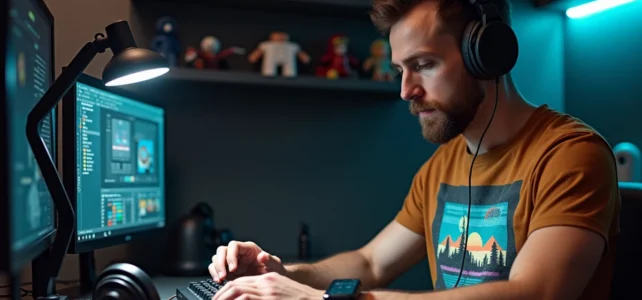
We connect a smart frame to display pixel art in the living room, place an articulated figurine on the desk, and launch a voice assistant to control the room’s gaming lighting. This year’s geek trends are no longer just about collecting items: they blend into daily routines, between functional tech and embraced pop culture.
The distinction between what remains a fleeting pleasure purchase and what becomes a lasting part of our habits deserves our attention.
Everyday geek gadgets: when the object must justify its place on the desk
We know the scenario: a gadget makes a buzz, we order it, it sits proudly near the screen for two weeks, then it ends up in a drawer. This year, the trend is pushing manufacturers to design objects that serve a real function beyond pure fandom.
LED pixel art lamps are a good example. Instead of simply reproducing a retro game sprite, recent models integrate a clock, a thermometer, or a notification display. The decorative object becomes a home information panel, and it is this dual use that ensures it a permanent place in the room.
This logic can also be seen in office accessories inspired by geek culture. XXL mouse pads with manga patterns, ergonomic wrist rests licensed from anime, backlit headphone stands: each primarily serves a practical role. The enthusiast looking for references and products in this spirit can explore what’s available on https://www.geeknation.fr/, where the catalog illustrates this convergence between the geek universe and real usage.
Opinions vary on this point, but the underlying trend is clear: a geek product that is only meant to be looked at loses its appeal much faster than a product that we use every day.

Portable consoles and mobile gaming: the usage that redefines the market
Portable gaming has changed its status. We no longer carry a console in our bag to “play between classes.” We use it on the couch while another household member watches TV, connect it to an external monitor at the office, or use it as a streaming platform.
The portable console is gradually replacing the desktop PC for casual gaming. Open system machines allow the installation of emulators, third-party launchers, and even productivity tools. This shift from a pure entertainment device to a versatile terminal explains why the segment remains strong.
Conversely, portable consoles built solely around a closed retro catalog are losing ground. Without regular software updates or cloud connectivity, they fall into the category of souvenir objects rather than everyday tools.
What distinguishes a durable purchase from a disposable retro gadget
- Compatibility with existing game stores or libraries to avoid buying the same title twice
- An operating system that accepts updates and third-party applications, not just a frozen firmware
- A video output or dock mode, which turns the device into a stationary gaming station when at home
- An active modding community that extends the lifespan well beyond the official catalog
Connected objects and geek decor: the boundary between collection and home automation
We accumulate fewer boxed figurines and invest more in pieces that interact with the environment. Holographic alarm clocks with anime themes, Bluetooth speakers hidden in replicas of video game objects, digital frames displaying generative art inspired by pop culture: geek decor fuses with home automation.
This convergence also changes the profile of the buyer. The audience equipping themselves is no longer just the otaku collector. It is also the person who wants a characterful interior and finds in the geek universe more original objects than standardized Scandinavian design.
Categories that risk losing their appeal
Some products will not survive this evolution towards integrated usage. Static figurines without function (neither lighting, nor storage, nor interactivity) cater to a shrinking market of pure collectors. Paper posters are declining in favor of digital frames. Fancy USB gadgets (miniature fans, desktop missile launchers) have largely disappeared from wishlists.
A geek object that only responds to fan purchase impulse does not last over time. The filter becomes: would I still use it in six months if the associated series or game no longer interests me?
AI and creative assistants: the new playground for tech enthusiasts
Artificial intelligence is no longer a watch topic for geeks; it is a tool we manipulate daily. Image generation from prompts, voice creation for modding projects, assisted writing for role-playing game scenarios: generative AI tools have become accessories for creative leisure.
Entire communities are emerging around the creative repurposing of these tools. On dedicated forums and servers, enthusiasts share their prompts, compare results from different models, and build workflows to produce visual or narrative content related to their favorite universes.
The risk, here too, is that of the gadget: if the AI tool is only used to generate images to post on a social network, the excitement fades quickly. The lasting uses are those that integrate into a project (role-playing game campaign, mod creation, gaming setup customization).
- Image generators used to design game assets or personalized stream visuals
- Text assistants for writing character sheets, narrative arcs, or home rules
- Voice cloning tools applied to amateur dubbing of mods or fan films
The common denominator of all these geek trends boils down to a simple constraint: the object or tool must serve a purpose beyond the moment of purchase. Enthusiasts investing in equipment, decor, or software this year are increasingly filtering by actual use. A gaming setup that also serves as a workstation, a figurine that lights up the desk, an AI assistant that fuels a creative project. The rest ends up in the drawer.